2026-11-05
Salamanca, Spain
IOS Press《Advances in Transdisciplinary Engineering》ISSN: 2352-751X
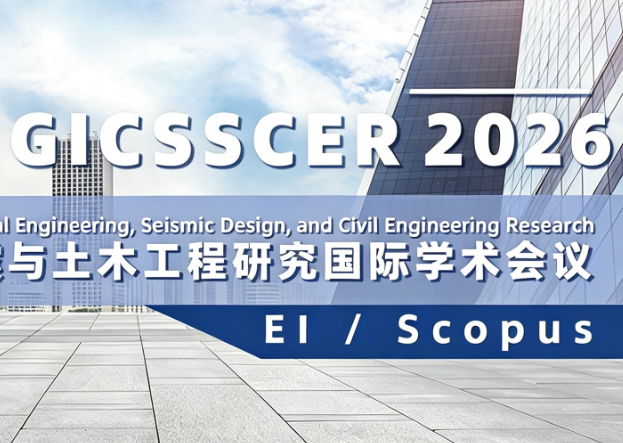
[IOS] 2026 International Conference on Structural Engineering, Seismic Design, and Civil Engineering Research (GICSSCER 2026) will be held in Salamanca, Spain during November 5‑7, 2026. The conference covers a wide range of topics, including structural performance analysis, seismic resistance design of building structures, civil engineering material research, geotechnical engineering and foundation treatment, bridge and tunnel engineering, disaster prevention and mitigation of civil infrastructure, and other core fields. It also focuses on hot directions such as intelligent monitoring of civil engineering structures, application of new green building materials, digital simulation for structural seismic assessment, and whole‑life‑cycle safety evaluation of civil engineering. Through keynote speeches delivered by industry elites, thematic seminars on cutting‑edge issues, paper presentations of innovative achievements, and other forms, participants will share the latest research results, discuss technical bottlenecks and practical solutions, and deepen academic exchanges and cooperative relations among global peers.
This conference is located in Salamanca, Spain, a city with profound historical heritage and strong academic research atmosphere. As a well‑known cultural and educational city in Southwest Europe, Salamanca not only has superior geographical advantages and complete conference supporting facilities, but also has accumulated a solid academic foundation in the fields of structural engineering, seismic engineering and civil engineering, providing a reliable guarantee for the smooth holding of the conference. All accepted and published papers will be included in the conference proceedings (produced by CPS) and submitted to authoritative databases such as EI Compendex, Scopus and Google Scholar for indexing, providing a high‑quality academic platform for researchers to display their achievements and enhance their academic influence.
GICSSCER 2026 sincerely invites colleagues from the global structural engineering, seismic design, and civil engineering research fields to gather in Salamanca, exchange innovative ideas, explore development opportunities, and work together to write a new chapter in the development of civil engineering and structural disaster‑reduction technology.

CPCIG CONFERENCE INTERNATIONAL PUBLISHING GROUP
GICSSCER 2026 invites researchers, practitioners to submit original research papers, review papers, case studies, and posters on a wide range of topics related to Structural Engineering and Civil & Infrastructure Engineering. We welcome submissions that address theoretical issues, empirical research, practical applications, and innovative approaches in these fields.
| Items | Registration Fee |
|---|---|
| Regular Registration(8 pages) | 800USD/ paper (8-10 pages) 5800 CNY/ paper (8-10 pages) |
| Extra Pages (Begin at Page 9) | 50 USD/ extra page 300 CNY/ extra page |
| Attendees without a Submission | 300 USD/ person 2000 CNY/ person |
| Attendees without a Submission (Groups) | 300 USD/ person(≥ 3 person) 2000 CNY/ person(≥ 3 person) |
| Purchase Extra Proceedings/Journal copies | 75 USD/book 500 CNY/book |
Schedule | ||
November 5, 2026 | 13: 00-17: 00 | Registration |
November 6, 2026 | 09: 00-12: 00 | Speeches of Keynote Speakers |
12: 00-14: 00 | Lunch | |
14: 00-17: 30 | Oral Presentations | |
18: 00-19: 30 | Banquet | |
November 7, 2026 | 09: 00-18: 00 | Academic Investigation |
The conference will be held in Salamanca, Spain. The exact venue details will be announced soon.
Salamanca, Spain.
Special rates have been negotiated with several hotels near the conference venue. Details will be provided to registered participants.
Discounted rates available for conference participants.
Papers will first undergo blind review by 2-3 experts. Accepted papers will be independently published by IOS Press《Advances in Transdisciplinary Engineering》ISSN: 2352-751X and ultimately indexed in EI and Scopus.
Your research will be accessible to a worldwide audience of researchers, educators, and practitioners.
Proceedings are indexed in major academic databases, increasing the discoverability and citation potential of your work.
Authors have the option to make their papers open access for wider dissemination.
Papers are preserved in digital format, ensuring long-term accessibility and impact.
Submit your paper through the online submission system by the deadline.
All submissions undergo a rigorous double-blind peer review process.
Authors are notified of acceptance/rejection within the specified timeframe.
Authors revise their papers based on reviewer comments and submit the final version.
Authors present their work at the conference (in-person or virtually).
Accepted and presented papers are published in the conference proceedings.
GICSSCER 2026 adheres to strict publication ethics guidelines. All submitted papers are checked for plagiarism using advanced detection software. Authors are expected to follow ethical practices in conducting and reporting their research, including proper citation of sources, disclosure of conflicts of interest, and adherence to ethical guidelines for research involving human subjects or animals.
Any concerns regarding publication ethics should be directed to the conference chairs.
All papers must be submitted through the online submission system. Please follow these steps:
All submissions undergo a rigorous double-blind peer review process. The review criteria include:
Fushuan Wen, Zhejiang University, Chin
Nadeem Javaid, COMSATS University Islamabad, Pakistan
Om Parkash Malik, University of Calgary, Canada
Riccardo Colella, University of Salento, Italy
Zhiwei Gao, University of Northumbria, UK
Technical Committee Co-Chair
Gheorghe-Daniel Andreescu, Politehnica University Timisoara, Romania
Muhammad Junaid, China University of Mining and Technology, China
Tomonobu Senjyu, University of the Ryukyus, Japan
Abu Zaharin Ahmad, Universiti Malaysia Pahang Al-Sultan Abdullah, Malaysia
Anton Dianov, Wenzhou University, China
Boris Andrievsky, St. Petersburg State University, Russia
Ching-Ming Lai, National Chung Hsing University, Taiwan
Dehong Zhou, University of Electronic Science and Technology of China, China
Duc Truong Pham, The University of Birmingham, UK
Farhad Shahnia, Murdoch University, Australia
Hasmat Malik, Universiti Teknologi Malaysia, Malaysia
H. Bülent Ertan, Middle East Technical University, Türkiye
Hugo Morais, Universidade de Lisboa, Portugal
Jiashen Teh, Universiti Sains Malaysia, Malaysia
Lee Sze Sing, Newcastle University, Singapore
Lijia Pan, Nanjing University, China
Mahendra Chilukuri, Vellore Institute of Technology, India
Mahmud Fotuhi Firuzabad, Sharif University of Technology, Iran
Mellah Hacene, University of Bouira, Algeria
Mihaela Popescu, University of Craiova, Romania
Mojtaba Ahmadieh Khanesar, University of Nottingham, UK
Muhammad Asim Amin, University of Genoa, Italy
Musa Yilmaz, Batman University, Turkey
Pierluigi Siano, University of Salerno, Italy
Sadegh Vaez-Zadeh, University of Tehran, Iran
Saeed Ahmed Khan, Sukkur IBA University, Pakistan
Sanjeev Singh, Maulana Azad National Institute of Technology Bhopal, India
Santanu Kumar Dash, Vellore Institute of Technology, India
Sathishkumar V E, Sunway University, Malaysia
Sri Niwas Singh, Indian Institute of Information Technology and Management, India

2026-12-18 | Guangzhou, China
2026-12-04 | Ningbo, China

2026-12-18 | Shanghai, China